
✨ Introduction
Exams are always a big challenge for students, especially at the Secondary (Class 9-10) and Higher Secondary (Class 11-12) levels. Every subject has hundreds of topics, formulas, theories, and definitions. Memorizing everything at once is very difficult.
👉 That’s why Subject-wise Guidance is very important.
👉 Short notes for each topic make study simple, save time, and improve understanding.
In this article, we will explore how to make subject-wise short notes, why they are important, and how they help in quick revision and better exam preparation.
Why Subject-wise Short Notes Are Important
Students often try to read entire chapters again and again. But this takes time. Instead, short topic-wise notes act like a map of the whole syllabus.
Benefits include:
1. Time Saving – You can revise an entire chapter in 10 minutes.
2. Better Memory – Writing short notes makes concepts stay longer in mind.
3. Quick Revision – Useful one night before exams.
4. Focused Learning – You only study the main points instead of extra details.
5. Better Presentation – Handwritten notes improve handwriting & exam writing style.
Extra Explanation:
Students often try to read entire chapters again and again. But this takes time. Instead, short topic-wise notes act like a map of the whole syllabus.
Benefits include:
1. Time Saving – You can revise an entire chapter in 10 minutes.
2. Better Memory – Writing short notes makes concepts stay longer in mind.
3. Quick Revision – Useful one night before exams.
4. Focused Learning – You only study the main points instead of extra details.
5. Better Presentation – Handwritten notes improve handwriting & exam writing style.
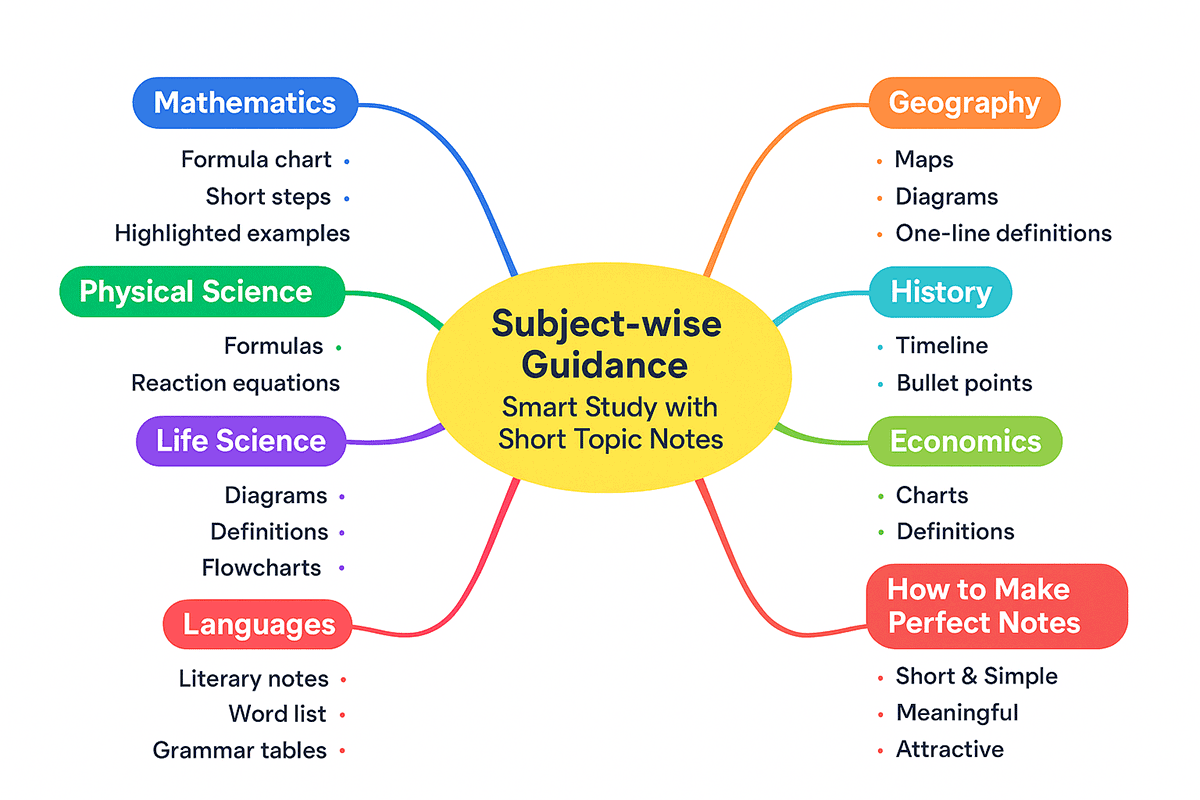
Mathematics
Mathematics needs formulas, theorems, and step-by-step solutions.
Tips:
– Make a formula chart for each chapter.
– Write important theorems in short steps.
– Highlight solved examples.
Example formulas:
(a + b)² = a² + 2ab + b²
(a – b)² = a² – 2ab + b²
(x + y)(x – y) = x² – y²
Extra Explanation:
Mathematics needs formulas, theorems, and step-by-step solutions.
Tips:
– Make a formula chart for each chapter.
– Write important theorems in short steps.
– Highlight solved examples.
Example formulas:
(a + b)² = a² + 2ab + b²
(a – b)² = a² – 2ab + b²
(x + y)(x – y) = x² – y²
Physical Science (Physics + Chemistry)
Science is full of laws, reactions, formulas.
Physics Notes:
– Write all formulas in one page per chapter.
– Example: Newton’s Laws, Ohm’s Law.
Chemistry Notes:
– Reaction equations in short form.
Example:
HCl + NaOH → NaCl + H₂O
Photosynthesis: 6CO₂ + 6H₂O → C₆H₁₂O₆ + 6O₂
Extra Explanation:
Science is full of laws, reactions, formulas.
Physics Notes:
– Write all formulas in one page per chapter.
– Example: Newton’s Laws, Ohm’s Law.
Chemistry Notes:
– Reaction equations in short form.
Example:
HCl + NaOH → NaCl + H₂O
Photosynthesis: 6CO₂ + 6H₂O → C₆H₁₂O₆ + 6O₂
Life Science (Biology)
Biology is theory-heavy.
– Use diagrams with labels.
– Write short definitions.
– Use flowcharts for processes.
Example (Photosynthesis Flow):
Sunlight → Chlorophyll → Glucose + Oxygen
Extra Explanation:
Biology is theory-heavy.
– Use diagrams with labels.
– Write short definitions.
– Use flowcharts for processes.
Example (Photosynthesis Flow):
Sunlight → Chlorophyll → Glucose + Oxygen
Languages (Bengali / English / Hindi)
Language subjects need literary notes + grammar rules.
– Write summary of prose & poems in short.
– Make a word list of difficult meanings.
– Grammar rules in table form.
Examples:
Present Simple: I read books.
Past Continuous: He was reading.
Future Perfect: I will have read.
Extra Explanation:
Language subjects need literary notes + grammar rules.
– Write summary of prose & poems in short.
– Make a word list of difficult meanings.
– Grammar rules in table form.
Examples:
Present Simple: I read books.
Past Continuous: He was reading.
Future Perfect: I will have read.
Geography
– Make notes using maps + diagrams.
– Write one-line definitions.
Example: Tributary = A river that joins a larger river.
Extra Explanation:
– Make notes using maps + diagrams.
– Write one-line definitions.
Example: Tributary = A river that joins a larger river.
History
History is about remembering dates, names, and events.
– Write in timeline format.
– Use bullet points for battles, reforms, leaders.
Extra Explanation:
History is about remembering dates, names, and events.
– Write in timeline format.
– Use bullet points for battles, reforms, leaders.
Economics
– Prepare charts of demand-supply, GDP, inflation.
– Keep definitions short.
Extra Explanation:
– Prepare charts of demand-supply, GDP, inflation.
– Keep definitions short.
How to Make Perfect Notes
Follow the SMART technique:
S – Short & Simple
M – Meaningful
A – Attractive (colors, highlights)
R – Relevant to syllabus
T – Time-saving
Extra Explanation:
Follow the SMART technique:
S – Short & Simple
M – Meaningful
A – Attractive (colors, highlights)
R – Relevant to syllabus
T – Time-saving
Tips for Effective Subject-wise Study
1. Keep a separate notebook for each subject.
2. Use highlighters & colors for key points.
3. Revise notes daily for 10–15 minutes.
4. Before exam, only revise from your short notes.
5. Make group study sessions where everyone exchanges notes.
Extra Explanation:
1. Keep a separate notebook for each subject.
2. Use highlighters & colors for key points.
3. Revise notes daily for 10–15 minutes.
4. Before exam, only revise from your short notes.
5. Make group study sessions where everyone exchanges notes.
Creative Idea: Revision Calendar
Make a calendar chart for subjects:
Day – Subject – Chapter – Notes Revision
Mon – Math – Algebra – ✔
Tue – Physics – Motion – ✔
Wed – English – Prose – ✔
Extra Explanation:
Make a calendar chart for subjects:
Day – Subject – Chapter – Notes Revision
Mon – Math – Algebra – ✔
Tue – Physics – Motion – ✔
Wed – English – Prose – ✔
Conclusion
Subject-wise short notes are not just a study tool—they are a success strategy. They help you:
– Learn quickly
– Revise fast
– Save time
– Write better answers