The Interior of the Earth Class 8 Question Answers 100% Common.
A. Very Short Question Answers:
1. What is meant by the crust?
Answer:
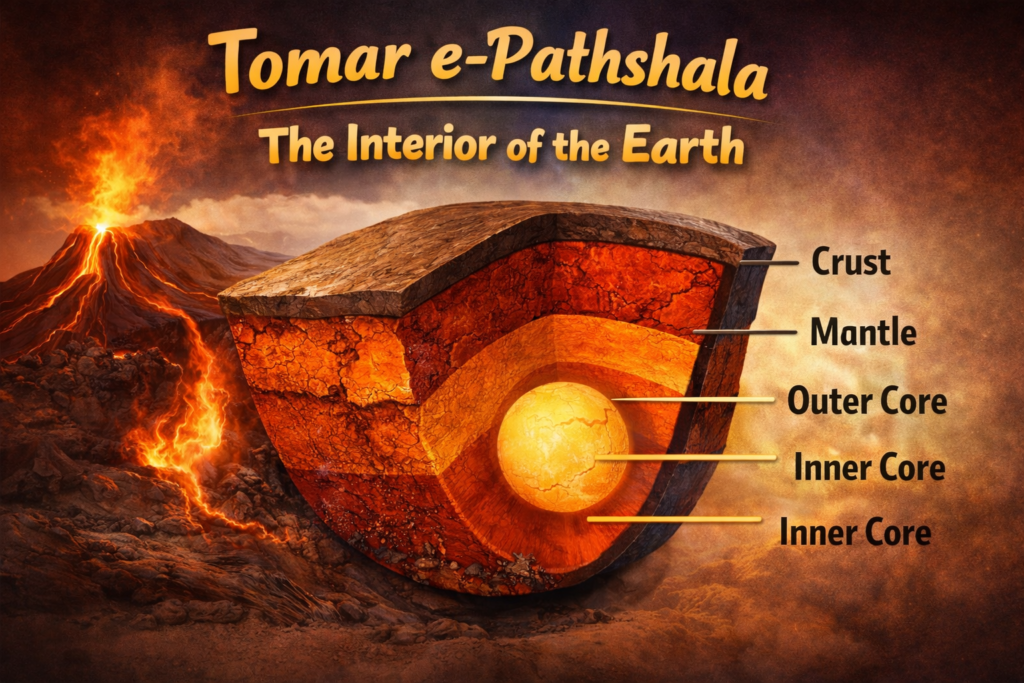
The layer of light and hard rocks that surrounds the Earth like a covering is called the crust.
2. Which layer of the Earth is called the crust?
Answer:
The outermost rocky layer of the Earth is called the crust.
3. Why is the crust called the lightest layer of the Earth?
Answer:
Because the materials of the crust are comparatively light and its density is lower than that of the other layers of the Earth.
4. Which rocks mainly form the crust?
Answer:
The crust is mainly composed of granite and basalt type hard rocks.
5. Which light elements are found in large amounts in the crust?
Answer:
Silicon, aluminium, and magnesium are found in large amounts in the crust.
6. Granite and basalt rocks are associated with which layer?
Answer:
Granite and basalt rocks are associated with the crust layer.
7. What is the average thickness of the crust beneath the ocean floor?
Answer:
The average thickness of the crust beneath the ocean floor is about 5 kilometres.
8. What is the average thickness of the crust beneath the continents?
Answer:
The average thickness of the crust beneath the continents is about 60 kilometres.
9. What is the average thickness of the crust as a whole?
Answer:
The average thickness of the crust as a whole is about 30 kilometres.
10. Which is the lightest layer among the three layers of the Earth?
Answer:
The crust is the lightest layer among the three layers of the Earth.
11. What is the relative density of the crust like?
Answer:
The relative density of the crust is low; therefore, it is light in nature.
12. How many times heavier is the crust compared to water?
Answer:
The crust is about 2–3 times heavier than water.
13. What is the name of the upper part of the crust?
Answer:
The upper part of the crust is called SIAL.
14. Which elements form SIAL?
Answer:
SIAL is composed of silica (Si) and aluminium (Al).
15. What is the lower part of the crust called?
Answer:
The lower part of the crust is called SIMA.
16. Which elements form SIMA?
Answer:
SIMA is composed of silica (Si) and magnesium (Mg).
17. What is the main difference between SIAL and SIMA?
Answer:
SIAL contains more aluminium, whereas SIMA contains more magnesium.
18. What is the importance of silicon in the crust?
Answer:
Silicon is one of the main components of the crust and plays an important role in rock formation.
19. Why is the crust called the Earth’s covering?
Answer:
Because the crust surrounds the Earth like a protective covering.
20. Above which layer is the crust located?
Answer:
The crust is located as the outermost layer of the Earth.
21. What is SIMA?
Answer:
The part of the Earth’s crust that is composed mainly of magnesium (Mg) is called SIMA.
22. What is the density of SIMA?
Answer:
The density of SIMA is about 2.9 g/cm³.
23. What is meant by the lithosphere?
Answer:
The layer formed by the entire crust and the uppermost part of the mantle is called the lithosphere.
24. What is the approximate depth of the lithosphere?
Answer:
The depth of the lithosphere is approximately 100 kilometres.
25. Which layers combine to form the lithosphere?
Answer:
The lithosphere is formed by the continental crust, oceanic crust, and the upper part of the mantle.
26. What are the main components of the lithosphere?
Answer:
The main components of the lithosphere are oxygen, silicon, aluminium, magnesium, and iron.
27. What is the meaning of the word ‘Lithosphere’?
Answer:
The word ‘Lithosphere’ comes from Greek, where ‘Lithos’ means rock and ‘sphere’ means layer.
28. Why is this layer called the lithosphere?
Answer:
Since this layer is made mainly of rocks, it is called the lithosphere.
29. How is the temperature distributed in the lithosphere?
Answer:
The temperature is lower in the outer part of the lithosphere and higher in the inner part.
30. How much does temperature increase per kilometre depth in the lithosphere?
Answer:
On average, the temperature increases by about 30°C per kilometre depth in the lithosphere.
31. What is the relative density of the lithosphere?
Answer:
The lithosphere is about 2–3 times heavier than water.
32. With which parts of the Earth is the lithosphere directly related?
Answer:
The lithosphere is directly related to the Earth’s crust and the upper part of the mantle.